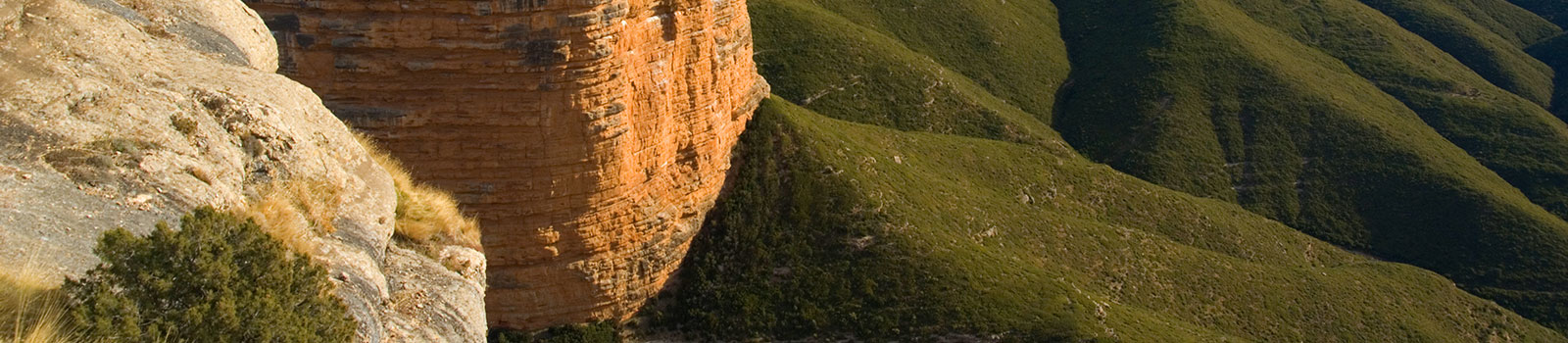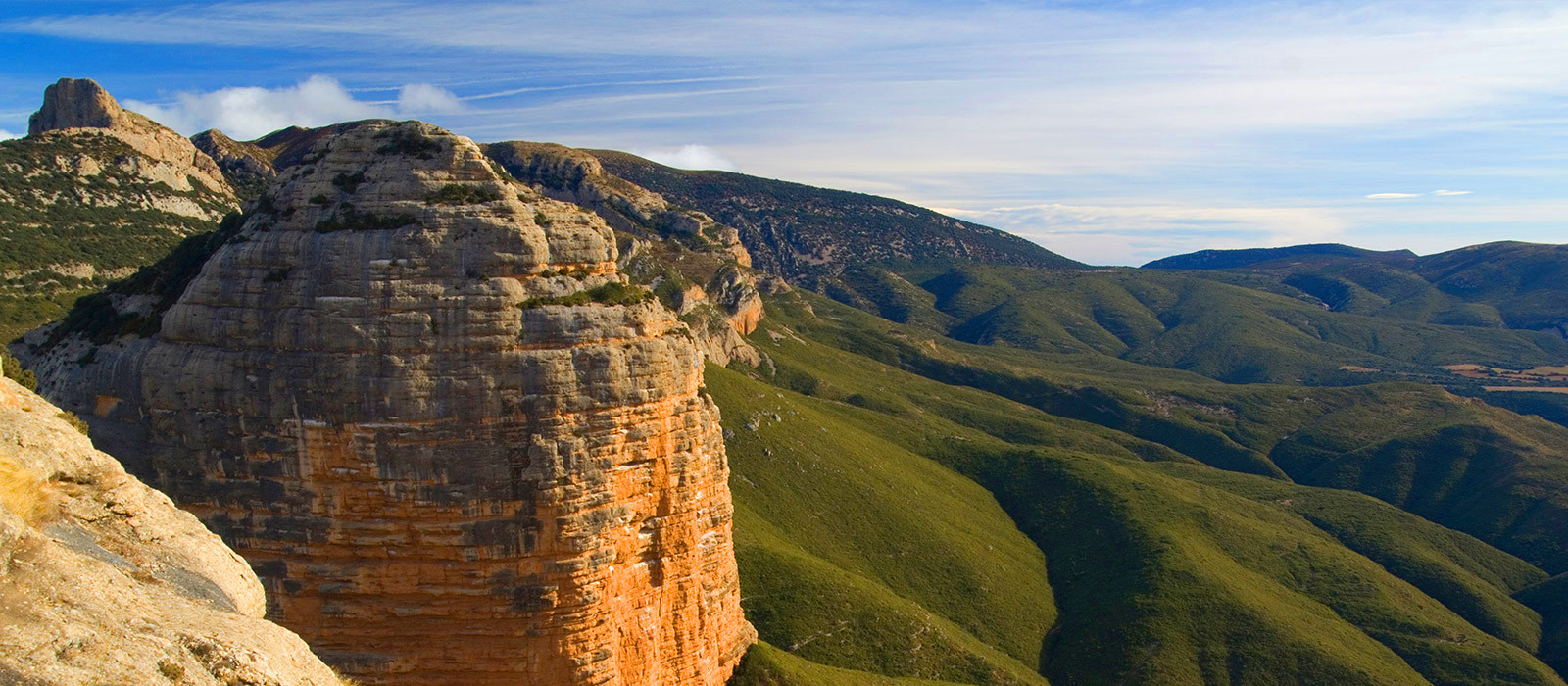
The county region of Hoya de Huesca is that area of transition between the pre-Pyrenees, the foothills of the mountain ranges, and the Ebro valley. A large portion of the territory, about a third, is located in the mountains with large forest areas, while the rest consists of great plains of cereal crops. At the centre, is the provincial and regional capital, the city of Huesca.
It extends over an area of 2,525 km2, and includes 40 municipalities with more than 120 towns. The county is home to 66,793 inhabitants, of whom around 50,000 are registered as living in the capital, Huesca.
Owing to its geographical location, with the transition from mountain to plain, Hoya de Huesca has a wide variety of natural assets and tourism resources. It can be divided into four separate zones:
The area of Reino de los Mallos, to the northwest. Pierced through its middle by the River Gállego, it is framed by the mountains of Santo Domingo, Loarre and Caballera, and smoothed by the plains of La Sotonera and the valley of Ayerbe. The A-132 road crosses through the region, and its nerve centre is the village of Ayerbe. The prime sites in this area are the rock formations of Riglos and Agüero, the white water rafting in the Gállego river, Loarre castle and the gothic church known as la colegiata de Bolea.
The Gratal and Guara mountain range, in the north and northeast of the county, has great potential for the diversity of areas it contains: from the gentle and peaceful solitary sites like the Arguis and Vadiello reservoirs, San Martín de la Val d´Onsera, the Bonés sierra, the valleys of Belsué and Nocito, to the so-called Linear Gothic route, a set of temples with murals retained in situ since the late thirteenth century.
The southern plains: the counterpoint to the mountains and canyons of the northern region. The nerve centre of this area is the village of Almudévar, with the steppe landscapes of Serretas de Piracés and Tramaced, as well as the nautical activity centre at Sotonera reservoir.
And finally, the city of Huesca, with the typical dynamism of a provincial capital. Visiting it is a must, for its pleasant historic old town, interesting museums, festivals and the various cultural activities carried on continuously throughout the year.
Loading events...