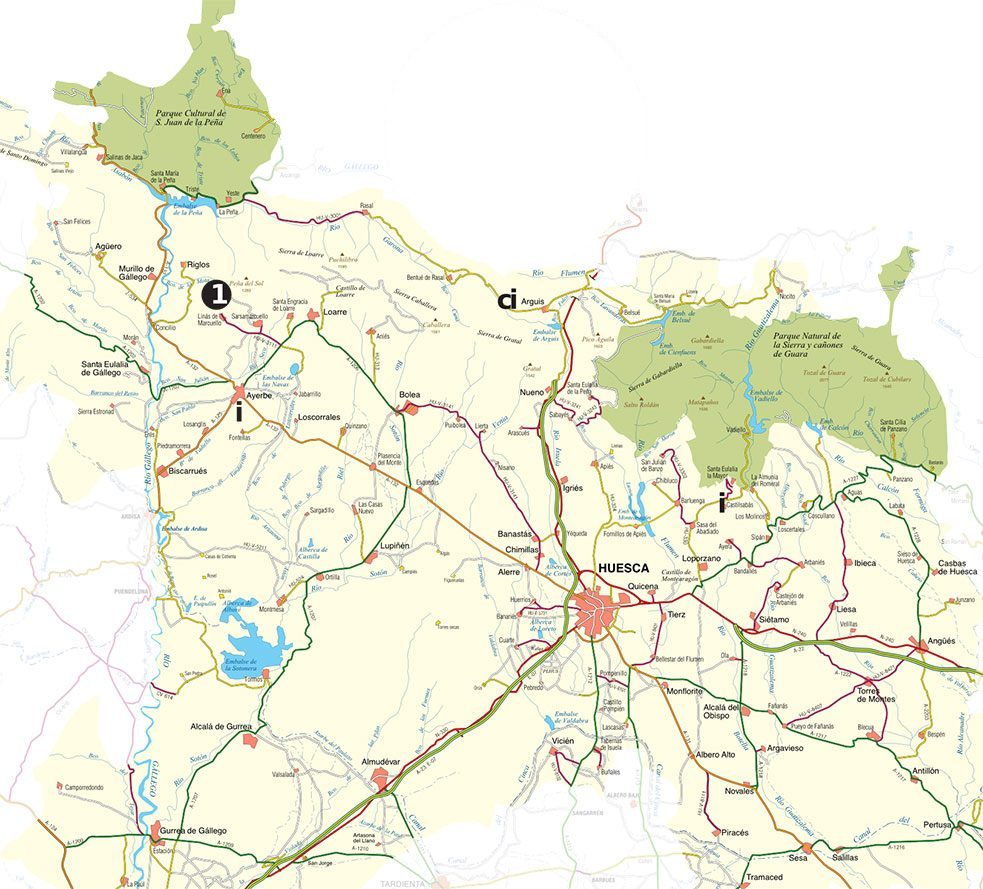
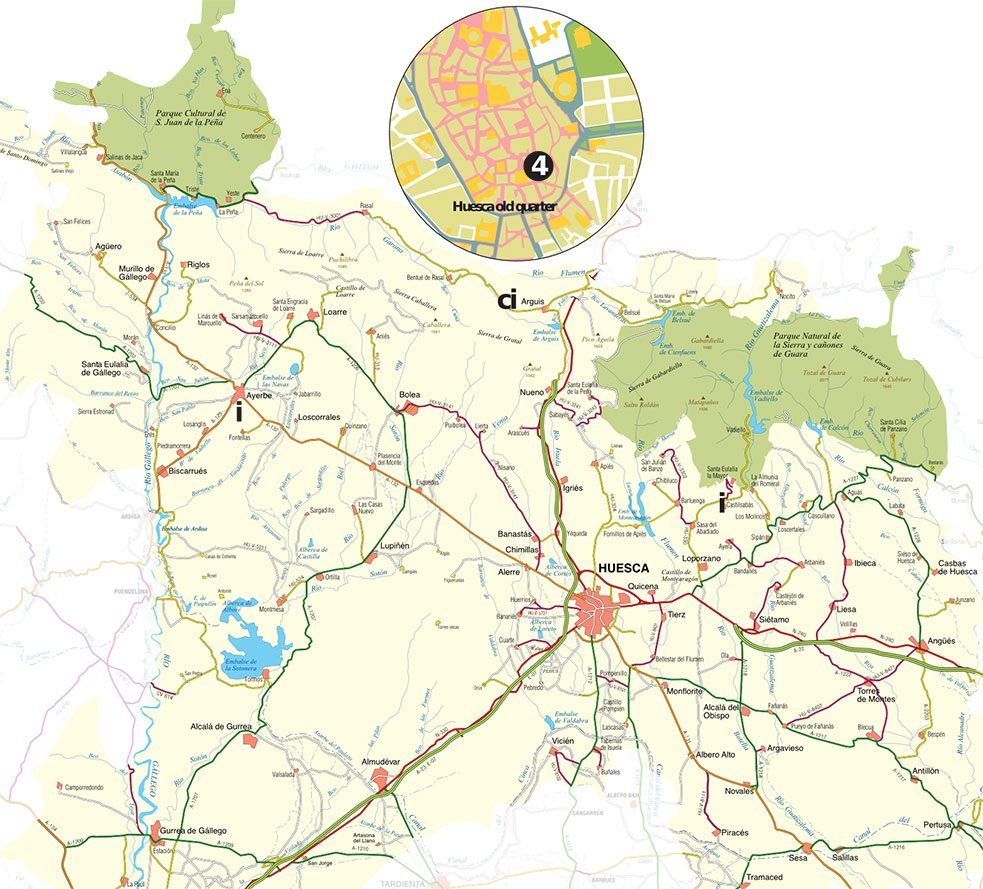
After crossing the village of Sarsamarcuello, there is a path that departs from the north along a forest track that is in perfect condition and leads towards the viewpoint. This bird-watching location offers magnificent panoramic views over the Mallos de Riglos (Riglos cliffs).
It is perfectly adapted for people with reduced mobility and visual impairments. There is a car park and an access ramp to the viewpoint. The viewpoint has indications and signs in Braille.
Do not miss: Pared de los Buitres (Vulture Wall), which accommodates one of the greatest griffon vulture colonies in Europe.


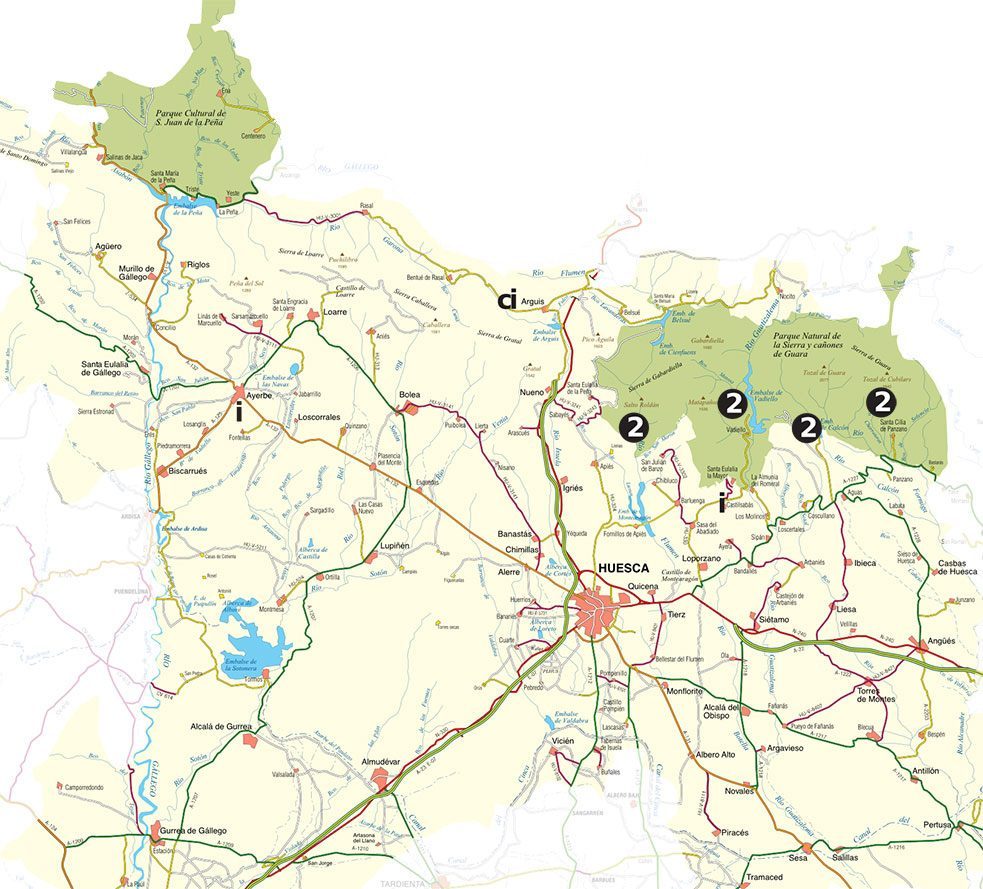
Four peculiar sites of the Parque Natural de Sierra y Cañones de Guara (Sierra and Guara Canyons Natural Park) offer views of spectacular landscapes, rocky formations as well as bird watching. The infrastructures are adapted for people with reduced mobility
Before reaching the village, continue along a track to the hill that accommodates the Salto de Roldán, along the sign-posted track.
Between the villages Aguas and Coscullano, continue along a road to Embalse de Guara.
It is situated on the top of the village, above a bird-breeding area, at the foothills of Tozal de Guara.
At Vadiello reservoir, you will find the viewpoint after crossing the dam.

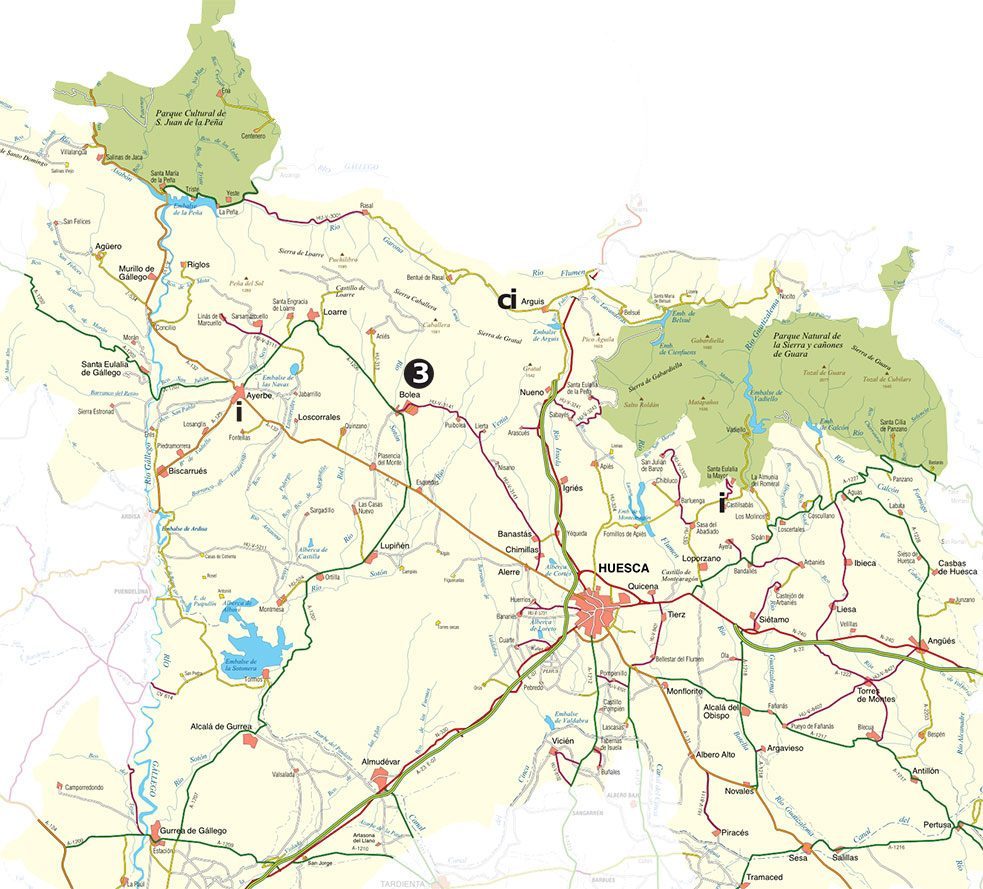
Heritage of Cultural Interest.
This superb temple is located at the top of the village of Bolea (Herrerías street), perfectly dominating the plain of La Sotonera (South) and the Caballera mountain range (North). This stunning construction was built during the transition between the Gothic to the Renaissance in the 16th century. Without a doubt, the gem of this building is the majestic polychrome Main Altarpiece, made between 1490 and 1503 by the Master of Bolea. It consists of 20 tempera painted boards and 57 polychrome wooden carvings.
People with reduced mobility can drive to the entrance to the temple using an auxiliary path that leads to the church. From here the 50m path travels along flat, uniform stone pavement. The church is accessed through a 1m folding ramp, which requires assistance from another person. Inside the building, the itinerary around the altarpiece and the lateral chapels is flat and even, with 0% inclination.
Heritage of Cultural Interest.
This Romanesque church was built between the 12th and 13th centuries and has a stunning cloister which was built during the period when it was used as a Benedictine monastery. It has subsequently been used as a Royal Pantheon for some of Aragon’s first monarchs.
There is a little wooden access ramp leading into the temple. There is also an aluminium folding ramp to the Romanesque cloister. Disabled people will need assistance from another person to manage this second option.







Loading events...